Why We Stopped Offering Same-Day Non-Emergency Appointments
Rushing through non-emergency HVAC calls leads to misdiagnosis and repeat breakdowns. We changed our scheduling model to ensure technicians have the time to fix your system right.

Your air conditioner is running nonstop but the house still feels warm, and you want to know exactly Why We Stopped Offering Same-Day Non-Emergency Appointments when you call for help. The short answer is that balancing a massive volume of immediate service requests with the absolute necessity of un-rushed, accurate diagnostics is impossible to do well on a rushed timeline. In our years of keeping Apache Junction homes comfortable, we've seen firsthand how the demand for cooling repairs skyrockets during a peak Arizona summer. The traditional industry response is to squeeze as many calls into a single day as humanly possible. However, our team realized that this high-volume approach actively harms homeowners by forcing technicians to rush through complex troubleshooting.
When a technician is staring at a schedule with twelve back-to-back stops, they do not have the time to properly evaluate a modern cooling system to ensure optimal energy efficiency under load. They are forced to find the fastest possible fix, swap a part, and run to the next house. We made the operational decision to officially halt same-day service for non-emergencies because A & A Cooling & Heating prioritizes thorough, un-rushed diagnostics over high-volume, rushed appointments. We want to ensure the job is done right the first time. To learn more about our comprehensive approach to home comfort, you can explore our complete HVAC Services.
Many homeowners do not realize that the standard dispatch model in the cooling industry is built on volume. Dispatchers are pressured to say "yes" to every caller, promising a technician will arrive by the end of the day. The hidden cost of this promise falls squarely on the homeowner. A pattern we see often in local tract homes is that a rushed diagnostic entirely misses the underlying cause of a breakdown. A technician might replace a blown fuse in fifteen minutes and leave, completely missing the failing fan motor that caused the fuse to blow in the first place. By refusing to overbook our daily schedule, our team protects you from this frustrating cycle of misdiagnosis and repeat breakdowns. Every customer receives a dedicated time block, guaranteeing our undivided attention.
To make a scheduled triage system work effectively, we have to be incredibly clear about what constitutes a true life-safety emergency versus a non-emergency that requires a dedicated diagnostic block. In a desert environment like Apache Junction, losing your cooling is never a minor inconvenience, but there is a distinct line between a situation that threatens your safety and a system that is simply struggling to keep up with the peak-heat of the afternoon.
Clear definitions prevent customer frustration and ensure that emergency slots remain open for those in immediate, physical danger. Here is how our dispatch team categorizes service requests to prioritize community safety:
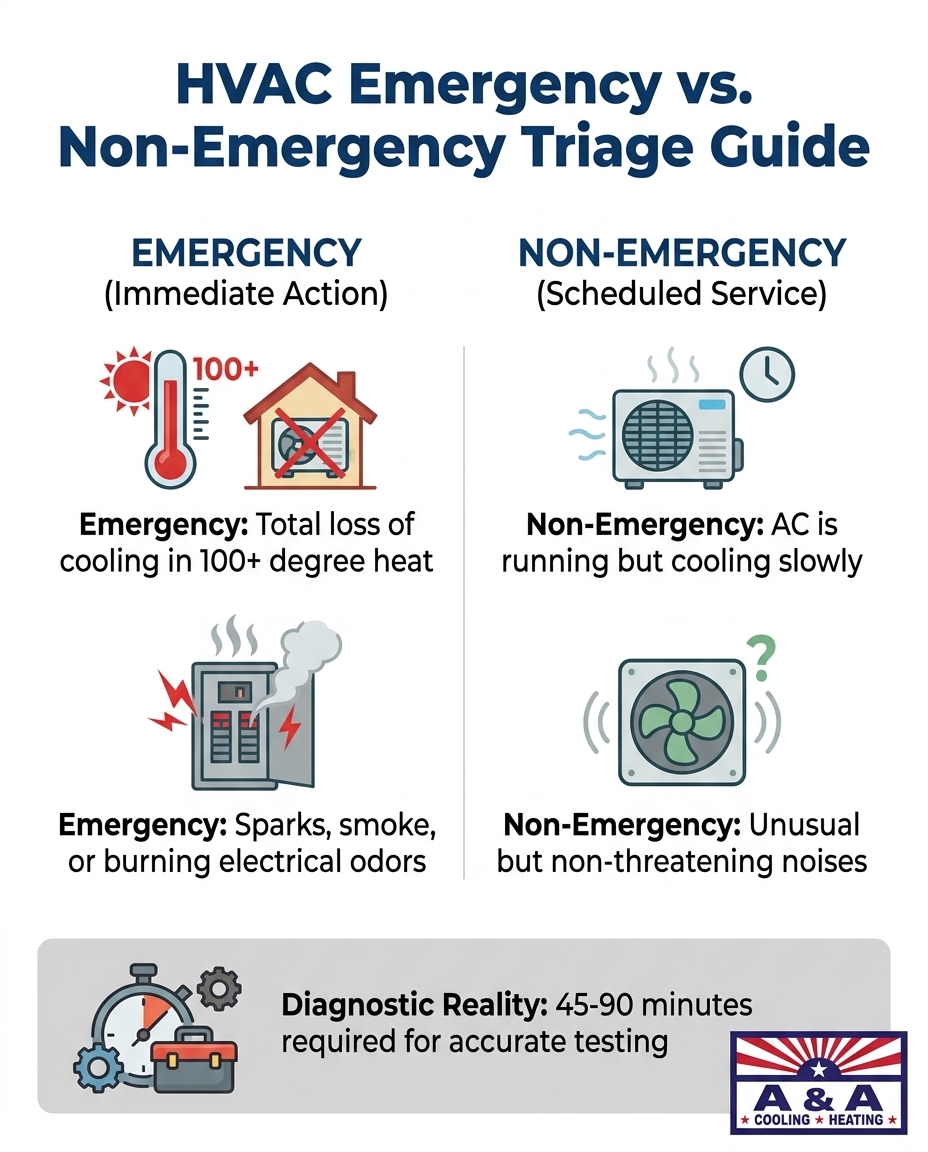
• Life-Safety Emergencies: These require immediate triage. This includes a total, 100% loss of cooling during extreme heat warnings, especially in homes with elderly residents, infants, or medically vulnerable individuals.
• Electrical Hazards: Visible sparks, smoke, or a burning electrical odor coming from your vents, air handler, or outdoor condenser is an immediate emergency. Turn off the breaker and call for help.
• Water Damage Threats: A severe, active leak from your indoor unit that is rapidly damaging drywall or pooling on the floor qualifies for expedited service to prevent structural damage.
• Non-Emergencies (Scheduled Blocks): The system is running but struggling slightly to maintain the set temperature during the hottest part of the day.
• Nuisance Noises: Strange but non-threatening noises (like a mild rattle or squeak) that do not impact the immediate cooling output.
• Minor Airflow Drops: Weak airflow in one or two rooms while the rest of the house remains relatively comfortable.
By scheduling non-emergencies into guaranteed diagnostic blocks for the following days, we ensure that when your appointment time arrives, you receive the full, focused expertise of our team.
The Problem: A common misconception is that fixing an air conditioner is as simple as plugging in a diagnostic computer, much like a mechanic does with a modern car. In reality, residential cooling systems require manual, multi-point testing across high-voltage electrical circuits, low-voltage communication lines, and pressurized chemical refrigerant lines.
The Cause: Modern AC systems are highly advanced. They feature complex electronic control boards, variable-speed compressor motors, and electronically commutated indoor blower motors. In our daily work across Apache Junction, our team typically sees that a technician needs a minimum of 45 to 90 minutes of dedicated testing to accurately pinpoint underlying issues in these advanced machines. You cannot simply look at a unit and know what is wrong.
The Solution: Reserving adequate time blocks for every non-emergency call allows our technicians to perform the required sequence of tests without checking their watches. When we arrive during your scheduled block, we are prepared to test the entire system, not just the single component that failed.
One of the most time-consuming aspects of a proper diagnostic is checking the refrigerant charge. You cannot just hook up gauges and read a number instantly. Proper refrigerant testing requires the system to run for at least 15 to 20 minutes so the pressures and temperatures can stabilize. A pattern we see often is systems struggling with energy efficiency under load because someone rushed this stabilization process, resulting in false data. This can lead to a technician overcharging or undercharging your system. Overcharging can destroy a compressor, while undercharging leaves you sweating through a peak Arizona summer.
Beyond refrigerant, electrical testing requires patience. A technician must test the capacitance of your run capacitors, measure the amp draw of the compressor and fan motors under load, and verify that the contactor is pulling in cleanly without pitting. Squeezing a non-emergency call into a 15-minute window inevitably leads to skipping these vital tests. We refuse to compromise your system's longevity by rushing the process.
Average July temperatures in the area often exceed 105 degrees, making a total AC failure a literal life-safety crisis rather than just a comfort issue. Having spent countless summer afternoons working on Apache Junction roofs, we know exactly how fast an uncooled home can surpass 90 degrees. For healthy adults, this is deeply uncomfortable. For the elderly, infants, and those with respiratory or cardiovascular conditions, it is physically dangerous.
The reality of summer grid strain: During peak heat waves, the sheer volume of failing systems across the valley is staggering. If an HVAC company attempts to treat every single call—from a minor rattle to a completely dead compressor—as an equal same-day priority, their schedule collapses. Technicians get bogged down on minor nuisance calls while vulnerable families are left waiting in dangerous heat.
Prioritizing true emergencies protects vulnerable populations when temperatures become a critical health hazard. We view our triage system as a community-focused necessity. By pushing non-emergency diagnostics to scheduled blocks, we maintain the flexibility to immediately dispatch a technician to a home where the cooling has completely failed. We reassure our non-emergency customers that their scheduled time block is guaranteed. Just as we protect emergency slots for those facing total failure today, we protect your diagnostic time block for tomorrow. It is a system built on mutual respect and community safety.
It is entirely natural to feel frustrated when you cannot get a technician out the exact same day you notice a problem. However, shifting your perspective reveals how waiting for a scheduled appointment directly benefits you and your system's overall health. A scheduled appointment means the technician arrives with the time needed to thoroughly inspect the entire system, from the outdoor condenser coils to the indoor evaporator and ductwork.
We believe in radical transparency: admitting that rushing leads to errors, and choosing instead to guarantee diagnostic accuracy. A rushed technician fixes the symptom; an un-rushed technician fixes the root cause. This proactive, un-rushed approach identifies secondary issues that a hurried technician would walk right past. For example, a failing capacitor might be the reason your fan stopped spinning, but a thorough diagnostic might reveal that a clogged condenser coil caused the capacitor to overheat in the first place. If we only replace the capacitor, you will be calling us back next week when the new one blows.
Proactive scheduling prevents costly repeat breakdowns in the middle of the season. Our team consistently finds that when we have the time to clean the coils, check the amp draws, and verify the refrigerant charge during your scheduled block, we leave your home knowing the system is genuinely stable. This is also why ongoing care is so valuable for minimizing sudden non-emergency issues before a peak Arizona summer even begins. Catching wear and tear early through a dedicated HVAC maintenance plan drastically reduces the chances of you ever needing to navigate the summer triage process in the first place.
If your system is categorized as a non-emergency and you are waiting for your scheduled diagnostic block, there are several safe, actionable steps you can take to manage your home's comfort without stressing the equipment further. It is important to stay comfortable while avoiding any actions that could void your warranty or create a safety hazard.
1. Reduce the heat load on your home: Close all blinds, curtains, and shades, especially on south- and west-facing windows. Blocking direct sunlight prevents the greenhouse effect from raising your indoor temperature.
2. Utilize ceiling fans strategically: Turn on your ceiling fans, ensuring they are spinning counter-clockwise to push air straight down. Remember that fans cool people, not rooms, so turn them off when you leave the space to save energy.
3. Check your air filter: A severely clogged air filter can cause your system to struggle, freeze up, or produce weak airflow. If your filter is gray and covered in dust, replace it immediately. We frequently see this simple step resolve minor performance issues.
4. Verify thermostat settings: Ensure your thermostat is set to "Cool" and the fan is set to "Auto." Sometimes, a family member accidentally bumps the setting to "Fan On," which can make the air feel humid and warm.
5. Avoid DIY mechanical repairs: Never attempt to open the electrical panel on your outdoor unit or handle refrigerant lines. These components carry high voltage and pressurized chemicals that require a licensed professional. Attempting DIY repairs can cause serious injury and void your manufacturer warranty.
6. Monitor the situation: Keep an eye on the system. If a non-emergency situation escalates—for example, the system stops cooling entirely, or you hear a loud, aggressive grinding noise—turn the system off at the thermostat and call us back to upgrade your ticket to an emergency response.
For more detailed guidance on safe checks you can perform around the house, review our AC troubleshooting tips to keep things manageable while you wait.
A true HVAC emergency involves a total loss of cooling during peak heat warnings, creating a dangerous indoor environment. It also includes any electrical issues, such as visible sparks, burning odors, or a system that repeatedly trips your circuit breaker. Finally, any cooling failure in a home with vulnerable individuals—like the elderly, infants, or those with medical conditions—is immediately prioritized as a life-safety emergency.
How long you can safely stay in a home without air conditioning depends entirely on the home's insulation and the outside temperatures. During a peak Arizona summer, indoor temperatures can reach dangerous, health-threatening levels within just a few hours. If your indoor temperature exceeds safe thresholds and your system has completely failed, we strongly emphasize seeking alternative shelter with friends, family, or a community cooling center while awaiting repairs.
Wait times increase during the summer due to an extremely high volume of total system failures across the valley. Furthermore, we require our technicians to spend 45 to 90 minutes on every diagnostic test to ensure accuracy. We refuse to apply quick band-aid fixes; ensuring that parts are sourced and installed correctly takes time, but it guarantees your system will remain reliable for the rest of the season.
Yes, if the system is still cooling partially and there are no electrical safety hazards, your repair can safely wait until a scheduled time block. Waiting ensures we have a dedicated window to accurately diagnose the root cause without rushing. Just monitor the system closely, and turn it off at the thermostat if it begins making severe mechanical noises or if ice starts forming on the indoor coils.
Modern air conditioners are highly sophisticated machines with complex electronic control boards that require precise multimeter testing to troubleshoot. Additionally, refrigerant pressures must run and stabilize for 15 to 20 minutes before a technician can take accurate readings. Rushing through these vital steps inevitably leads to misdiagnosing the root cause of the failure, resulting in wasted money and repeat breakdowns.
Extreme heat causes a massive spike in catastrophic system failures, straining the entire local service grid. When temperatures soar, dispatchers must constantly reroute technicians to handle life-safety emergencies where total cooling loss threatens vulnerable residents. This necessary triage means that routine maintenance and minor, non-emergency performance issues must be scheduled for later dates to keep emergency response times as short as possible.
Ultimately, the decision to stop offering same-day non-emergency appointments is a firm commitment to quality control. We know that waiting for service is never fun, but our decades of experience tell us that paying for a rushed repair that breaks down again a week later is far worse. By implementing a strict triage system, we protect the vulnerable residents of Apache Junction during extreme heat while guaranteeing that every single customer receives the un-rushed, meticulous diagnostic testing their equipment requires.
When your scheduled time arrives, you have our technician's undivided attention. We will test thoroughly, diagnose accurately, and provide permanent solutions rather than temporary fixes. If your system is acting up, or if you want to get ahead of the heat with a thorough inspection, reach out to our team today to Schedule HVAC Service. We are dedicated to ensuring your home stays reliably cool, and that means doing the job right the very first time.


A & A is professional, fast, and honest. They have a hometown work ethic and take care of you almost like family! Dave is a great tech and I would recommend him to anyone. We had our AC go out and they came out and stayed past 7 pm to keep us cool on a day when temps were going to reach 105! THANK YOU!

Excellent service, they are very dependable and upfront about the work. I would highly recommend this company for any heating or cooling issues. Being a snowbird it’s often scary finding reliable services, this is one company you can count on.

A & A is professional, fast, and honest. They have a hometown work ethic and take care of you almost like family! Dave is a great tech and I would recommend him to anyone. We had our AC go out and they came out and stayed past 7 pm to keep us cool on a day when temps were going to reach 105! THANK YOU!